Module 1: Introduction to AI Agents
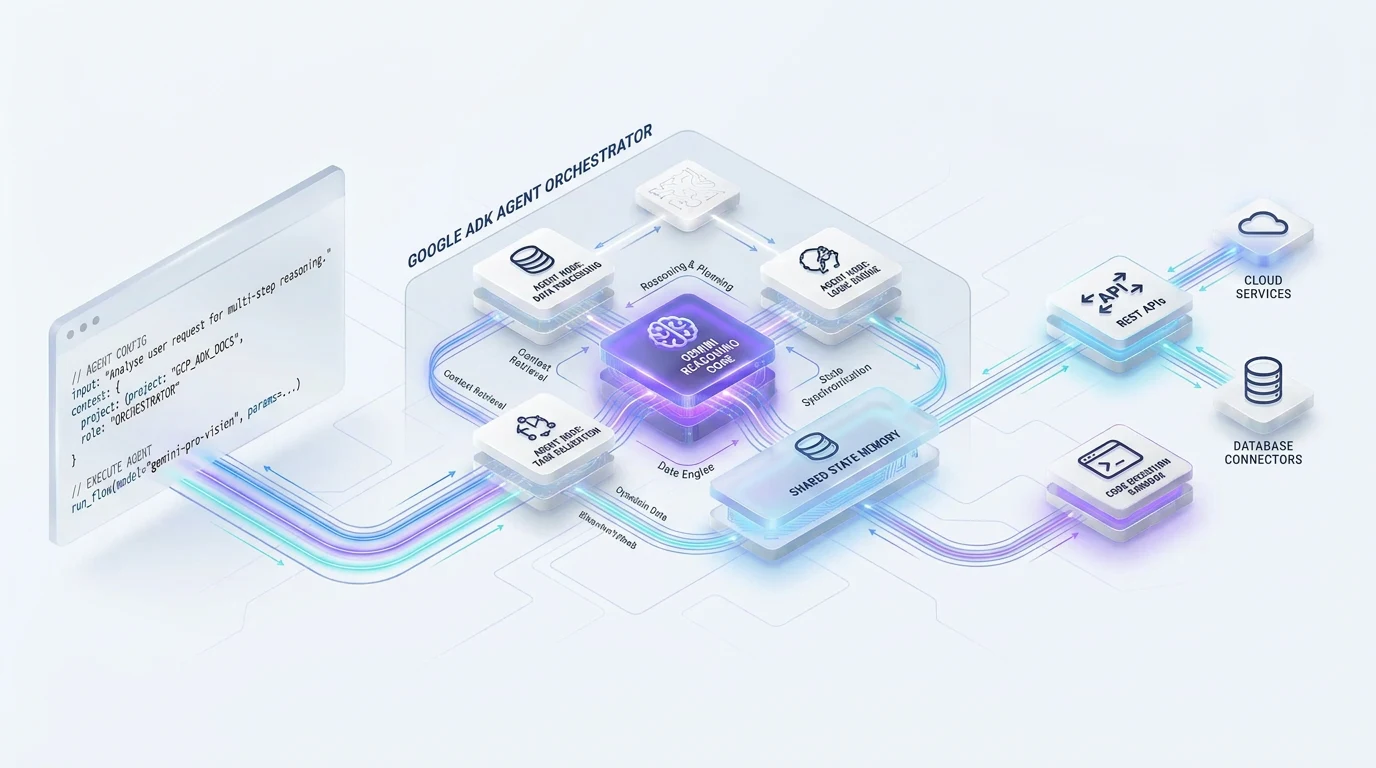
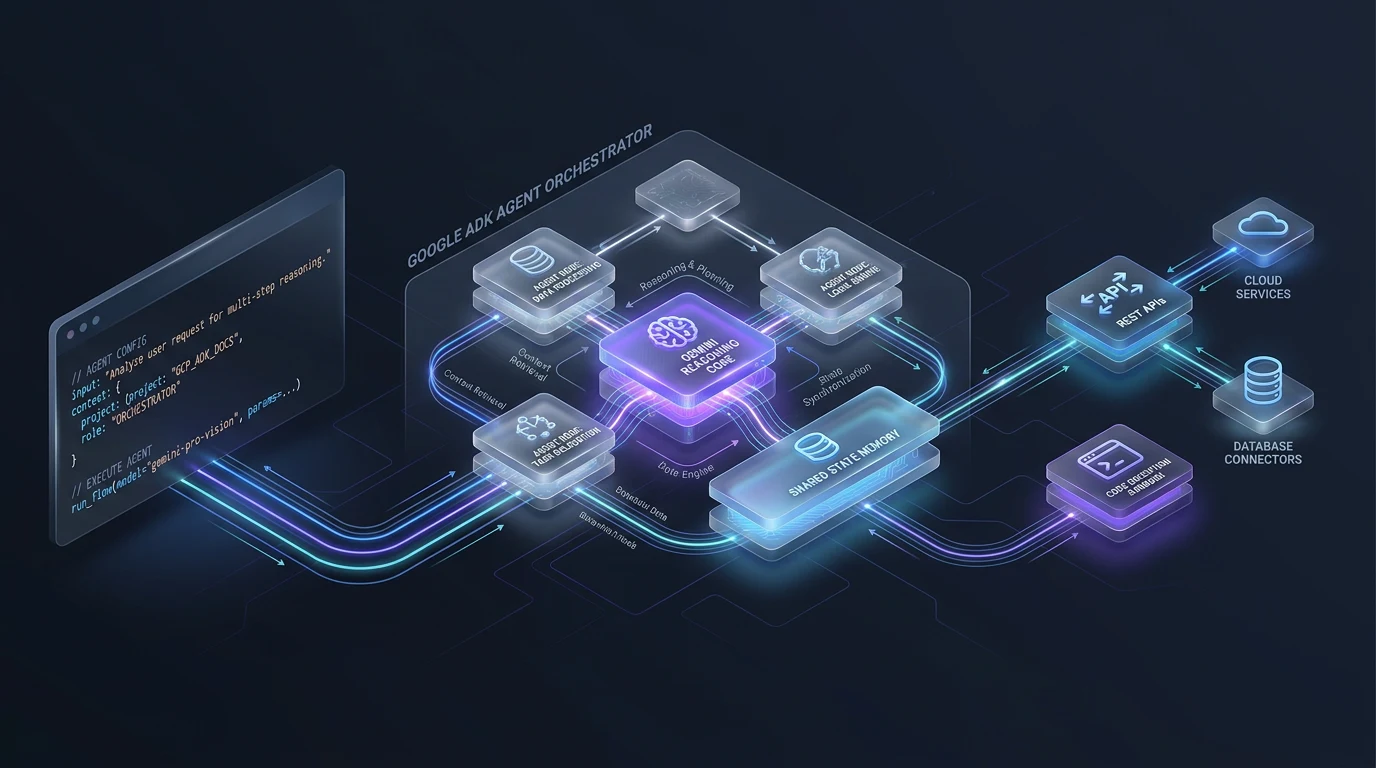
Module 1: Introduction to AI Agents & Google ADK
Theory
The Rise of AI Agents
In the rapidly evolving landscape of artificial intelligence, we are moving beyond simple chatbots and predictive models. The next frontier is AI Agents: autonomous systems that can understand goals, make plans, and use tools to interact with their environment to accomplish complex tasks.
Unlike traditional programs that follow a rigid set of instructions, an agent can reason, adapt, and act on its own. This paradigm shift is powered by the sophisticated reasoning capabilities of Large Language Models (LLMs) like Google's Gemini.
What is an AI Agent?
An AI Agent is a system that can:
- Perceive its environment: It takes in information, such as a user's request in natural language.
- Reason and Plan: It uses an LLM as its "brain" to break down a high-level goal into a sequence of smaller, actionable steps.
- Act using Tools: It executes those steps by interacting with its environment. This could mean calling an API, searching a database, running a piece of code, or even using another agent.
- Observe the Outcome: It analyzes the results of its actions and adjusts its plan accordingly until the goal is achieved.
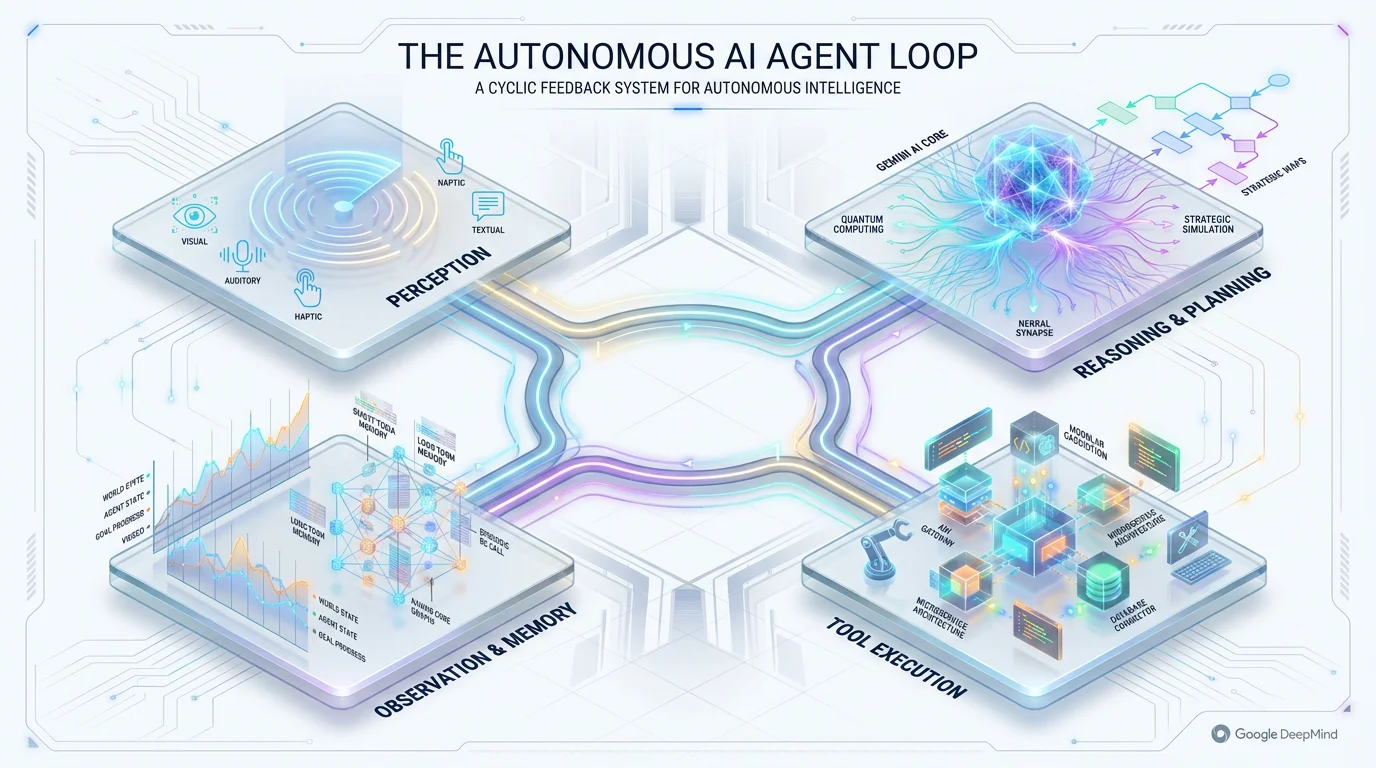
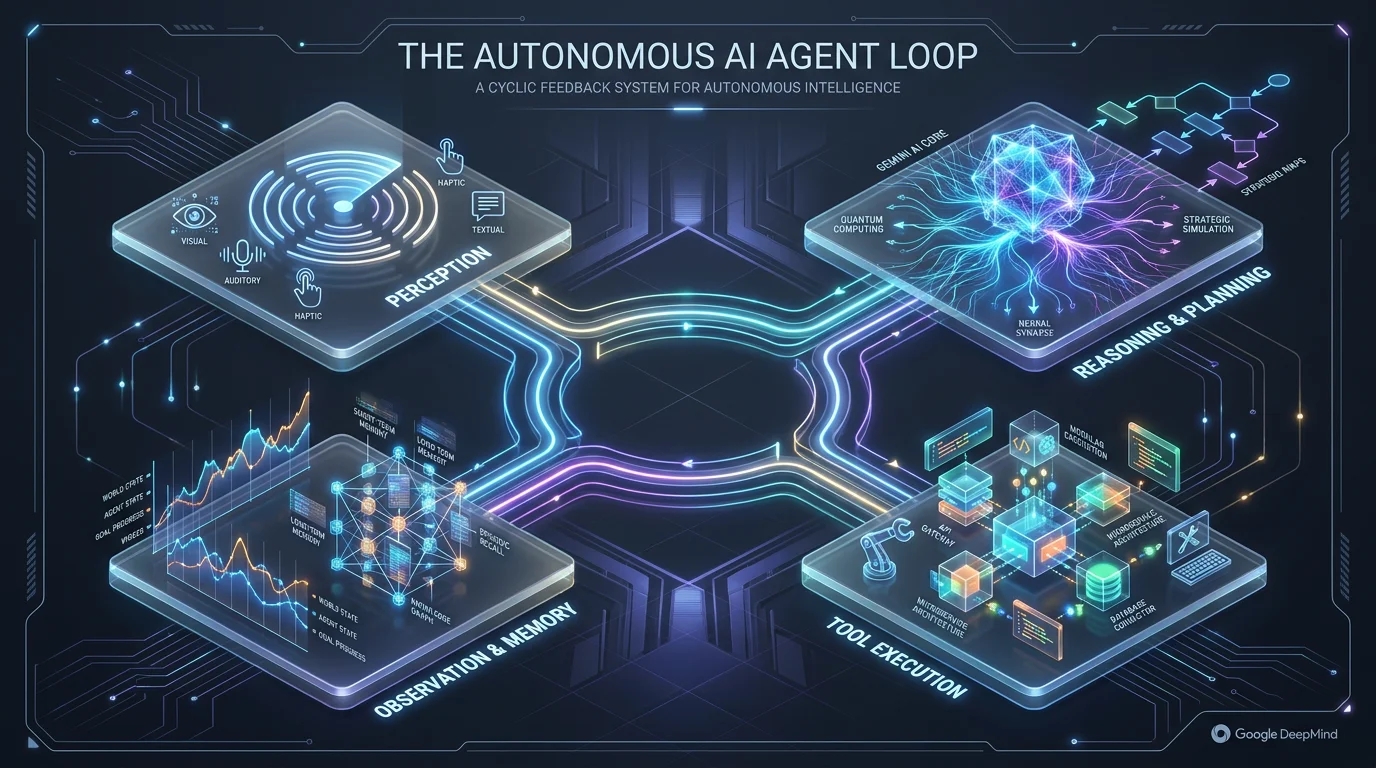 Figure 1.1: The 4-stage autonomous agent execution loop in Google ADK — from natural language perception to reasoning, tool dispatching, and state memory updates.
Think of an agent as an autonomous worker that you can delegate complex tasks to, moving from just "chatting" with an AI to collaborating with it.
Introducing the Google Agent Development Kit (ADK)
Building robust, production-ready AI agents is a complex task. It involves much more than just prompting an LLM. You need to manage conversation history, handle tool integrations, orchestrate complex workflows, evaluate performance, and deploy the agent to a scalable infrastructure.
The Google Agent Development Kit (ADK) is a comprehensive framework designed to solve these challenges. It provides developers with the tools and structure needed to build, manage, evaluate, and deploy sophisticated AI-powered agents seamlessly on the Gemini Enterprise Agent Platform (formerly known as Vertex AI).
The ADK Philosophy
The ADK is built on a philosophy of modularity, flexibility, and scalability. It provides a set of core primitives that you can compose like building blocks to create everything from simple, single-purpose agents to complex, multi-agent systems.
Core Concepts of ADK 2.0: The Graph Architecture
ADK 2.0 represents a major evolution in how we build AI systems. It moves away from monolithic agents and rigid hierarchies toward a flexible Graph-based Architecture.
- Node: The fundamental building block. A node is a discrete unit of work. It can be an Agent (powered by an LLM), a Function Tool (pure code), or even another nested Workflow.
- Edge: Defines the flow of control and data between nodes. Edges can be linear (sequential), branched (conditional), or even cyclic (loops).
- Workflow: The container and orchestrator. A Workflow defines the structure of your graph and manages the transitions between nodes using the Workflow Runtime.
- App & Runner: The infrastructure layer. An App wraps your root agent or workflow, and a Runner (like the
InMemoryRunner) executes it, handling session state and telemetry. - Tool: Capability interfaces that can be assigned to Agent nodes (e.g., Search, Database access).
- Session & State: Manages the context and memory of an interaction, ensuring continuity across the graph.
In this course, you will learn to think in Graphs and Nodes, mastering ADK 2.0 to build scalable, production-grade AI applications.
Key Takeaways
- AI Agents are autonomous systems that perceive, reason, and act using tools.
- ADK 2.0 uses a Graph Architecture where Agents and Tools are Nodes connected by Edges.
- The Workflow Runtime is the engine that orchestrates complex multi-agent interactions on the Gemini Enterprise Agent Platform.